The New Era of Growth: Why Channels Are Fading and Systems Are Taking Over
For the first time in years, I feel the growth landscape has fundamentally shifted. We used to see growth as a question of where to acquire users — which platform still had arbitrage, which channel was cheap, which format was converting. Today, those questions matter far less than they once did.
Growth is no longer a hunt for the next traffic source. It has become the discipline of designing a system — an ecosystem that compounds value internally, not externally.
And that shift is bigger than we think.
1. Why Traditional Channel-Led Growth Is Losing Power
For a long time, "growth" meant "channel optimization."
You found platforms in their golden phase. You learned their mechanics, bought inventory, tuned your CAC, and scaled the arbitrage window while it lasted. Facebook in its early days. TikTok in its hyper-growth years. Google Ads when the competition was thin.
Every marketer had a favorite channel where CPI was low, attribution was identifiable, and ROI calculated cleanly.
That era is ending.
Across platforms, three forces have reshaped the environment:
1) Platform consolidation & algorithmic opacity — The big platforms now operate more like closed ecosystems than independent channels. Their targeting algorithms converge. Their advertising inventory is optimized. And their margins are designed to extract full willingness-to-pay from all advertisers.
2) CAC inflation & diminishing returns — As competition increases and arbitrage disappears, the cost of "renting" attention skyrockets. You can no longer buy traffic cheaply and make up the margin with conversion.
3) User attention fragmentation — Even if you find a new channel, users no longer stay still long enough for you to harvest predictable ROI. Attention moves faster than media buying cycles.
In this environment, relying on channels alone is like trying to sail with no wind. It's possible, but only if you're willing to row endlessly at enormous cost.
This is exactly why the old growth flywheel conversations mattered — because they described a world where users generated momentum inside the product, instead of marketers generating momentum outside of it.
2. The New Reality: System-Based Growth Instead of Channel-Based Growth
The most successful products today aren't winning because they found an underpriced channel. They win because they've built an ecosystem that feeds itself.
A modern growth system is not a funnel. It is a loop, where:
- user value creates usage
- usage produces shareable or collaborative outputs
- those outputs attract new users
- and new users generate more value to start the loop again.
AI products make this loop even more powerful.
Let's take a real example: Lovable, an AI-powered app builder.
A new user arrives on the landing page → the AI asks a few intent-shaping questions ("What do you want to build?") → it instantly generates a functional prototype → the user tweaks it, shares it, or shows it to a teammate → that teammate gets curious ("Wait, you built this in 10 minutes?") → they sign up too → their usage produces more prototypes, more variations, more prompts, more context → and the ecosystem compounds.
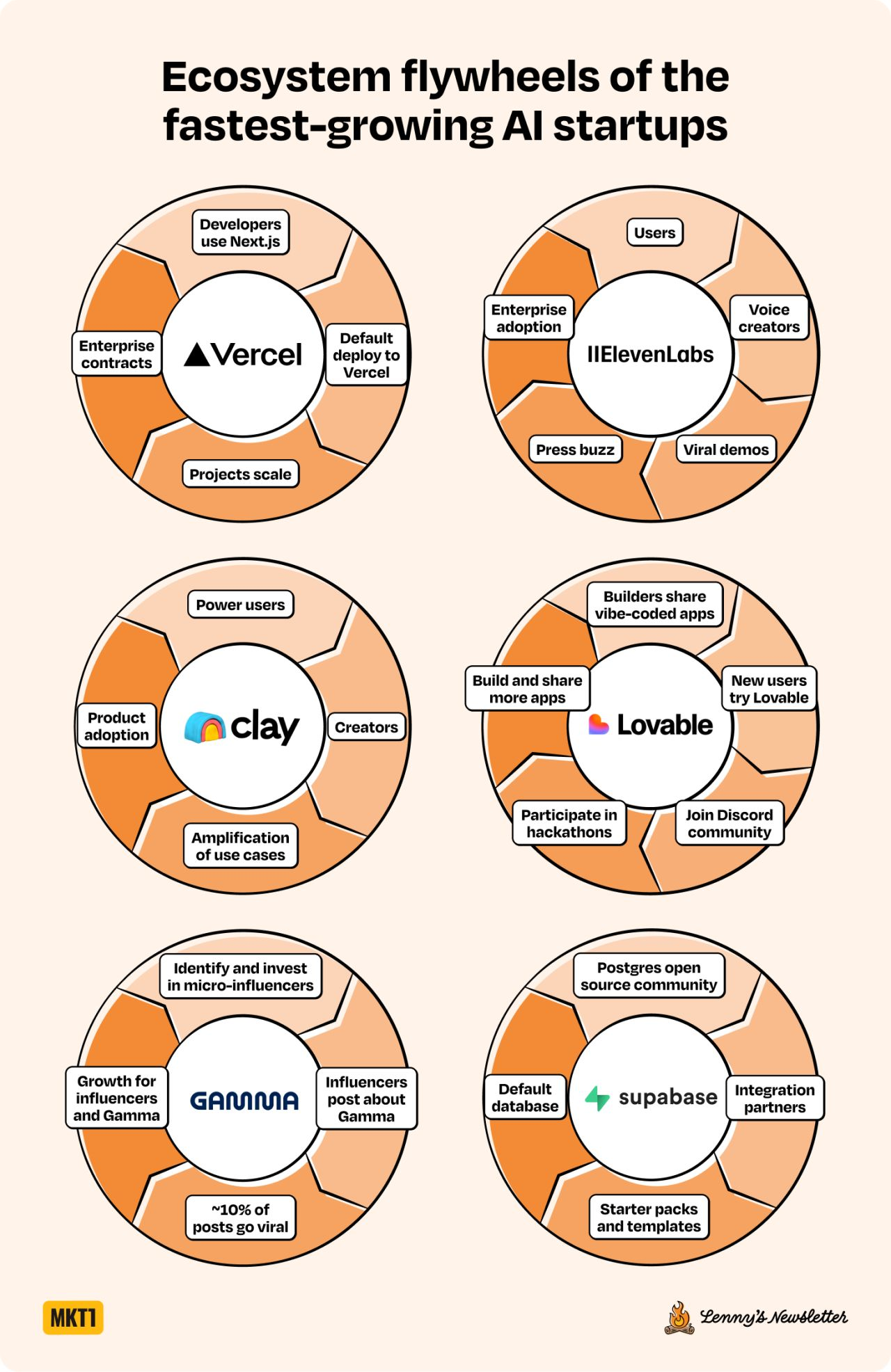
What used to be a linear funnel now behaves like a self-expanding loop.
Every touchpoint — onboarding, activation, retention, and sharing — stops being a rigid step and becomes a real-time feedback mechanism.
And AI doesn't just automate these loops; it accelerates them by:
- removing complexity from onboarding
- shortening time-to-value from days to minutes
- surfacing the strongest user intents through behavior signals
- detecting drop-off patterns before churn happens
- generating artifacts (apps, screenshots, demos) that naturally spread
In other words: AI makes the flywheel spin earlier, spin faster, and with almost no external fuel.
At this point, "growth" is no longer determined by your channel spend. It's defined by the velocity of your internal loops — how quickly a user can create value, show value, and circulate value back into the system.
3. When Product Experience Becomes CAC
A subtle but important shift has happened:
Your trial experience is your real customer acquisition cost.
Every click, every prompt, every onboarding screen — they are all part of a hidden CAC you're paying in product complexity, conversion friction, and user frustration.
In the past, CAC was predictable: CPC × CTR × CVR → one clean number.
Today?
If your onboarding isn't tight, your CAC doubles. If your product doesn't help users succeed in 5 minutes, your CAC is wasted. If your activation loop isn't designed to hit an "aha moment" quickly, your CAC leaks.
The product experience has become the most meaningful cost center in the entire growth equation. Not because product replaced marketing, but because product now determines the efficiency of every dollar you spend outside the product.
Growth happens where users succeed — not where marketers spend.
4. The Rise of PLG Roles: The New Cross-Functional Growth Operator
This shift also explains why Product-Led Growth (PLG) roles are becoming so central.
When growth becomes systemic and loop-based, companies need operators who can:
- understand product behavior
- design activation mechanics
- identify compounding loops
- guide onboarding flows
- and analyze the economics of internal vs. external acquisition
The next generation of growth leaders will not be "performance marketers" or "product managers" in the traditional sense. They will be system architects — professionals who understand product, analytics, user value, loop design, and AI-driven personalization.
Their skill set will sit at the intersection of:
- Product Design – for onboarding, value moments, and habit loops
- Data Science – for understanding user behavior patterns
- Growth Mechanics – for compounding systems
- AI/Automation Literacy – for building adaptive experiences
- Storytelling – for external amplification
These roles will define the new growth discipline. Not because growth became more complicated — but because it became more cross-functional.
5. Final Thought: Growth Is Becoming an Internal Engine, Not an External Hunt
If the last decade was about finding the best channels, the next decade will be about building the best systems.
AI will accelerate this transition. PLG will shape the operating model. And growth leaders will increasingly resemble product strategists — blending user insight, loop mechanics, and ecosystem thinking.
Because growth is no longer where you buy attention.
🔗 Read More
If you enjoyed this post, you might also like: